Work in the OpenSolaris project is done under a constitution, which lays out how the community is structured.
Sort of, anyway. The constitution covers both the Governing Board and Community Groups, but in fact most of the activity around OpenSolaris takes place in User Groups (where people get together) and Projects (where code is written), and also in Communities of Interest (where technologies get discussed). None of these last 3 parts of the organization are defined by the constitution.
Indeed, they are hardly mentioned. Even though community groups are tasked by the constitution to initiate and manage projects to achieve their objectives, it isn't clear (because projects aren't defined) whether the projects established by a Community Group are the same as the Projects hosted on OpenSolaris.org, or whether project is used in the generic sense.
As for user groups, they are managed as projects. While I believe this to be correct in the sense that they can reuse the machinery and infrastructure, they should explicitly be called User Groups and given their own place in OpenSolaris as first class citizens.
And then we have Communities. Originally, when OpenSolaris came about, a bunch of communities were created. And these were Communities of Interest - focussed around a general technical area (for example, performance), or a specific technology (dtrace). Then the constitution came along, and created the notion of Community Groups. As part of the bootstrapping process, many of the original Communities became Community Groups, while some did not. The whole thing is a total mess, and part of that mess is overloading the notion of a community to mean two different - and often incompatible - things. I think we need to find a way to clearly separate the mechanism of governance from the day to day interactions of users in the community.
And then there's the amount of effort wasted by the current structures. Creating a project means you have to persuade a community group to authorise it (and not all communities can, remember, and of those that can persuading the machinery to work at all and getting the approval can be a painful and time-wasting process). Creating a community involves redefining the governance hierarchy and invites considerable debate.
Where to go from here, then? I think we need to call out the existence and standing of projects and user groups in the constitution; we need to make the creation of those parts of the structure be lightweight and effortless, so that anyone can just do it; we need to have a structure whereby projects and user groups are monitored and helped (sponsored, if you like); we need to revert communities to be communities of interest (which can then be created as required with no effort) and build a new governance infrastructure that just gets out of the way and lets people work on bettering OpenSolaris as fast as they're able to without putting roadblocks in their way.
Monday, March 17, 2008

Tuesday, March 11, 2008
OGB: expectations
It's clear that the OpenSolaris community isn't in a particularly healthy state. While there's a lot of real work being done, the community is dogged by infighting - not to mention a distrust of Sun and its motives.
Part of this comes from a lack of clarity and focus. In particular, we're guilty of not even setting expectations, let alone meeting them.
Without clear expectations, we have a problem - everyone in the community makes up their own expectations of what they can achieve and what everyone else should be doing. All those expectations are going to be different, and everyone is going to end up frustrated and disappointed.
So one important thing the incoming OGB is going to have to do is to set everyone's expectations appropriately. People (and Sun) need to understand what can and can't be achieved - even if an accurate setting of expectations means they're quite low to start with.
Part of this comes from a lack of clarity and focus. In particular, we're guilty of not even setting expectations, let alone meeting them.
Without clear expectations, we have a problem - everyone in the community makes up their own expectations of what they can achieve and what everyone else should be doing. All those expectations are going to be different, and everyone is going to end up frustrated and disappointed.
So one important thing the incoming OGB is going to have to do is to set everyone's expectations appropriately. People (and Sun) need to understand what can and can't be achieved - even if an accurate setting of expectations means they're quite low to start with.
Sunday, March 09, 2008
OGB: Bio
Glynn asked the OGB nominees to provide brief affiliations and a Bio. I've done the affiliation already, so here's a brief history of me:
I come from Nottingham, England. I read physics at St. John's College, Oxford, and stayed on to do a D. Phil. in Theoretical Astrophysics in the Department of Theoretical Physics. Computing at this point was VAX VMS based - I managed to get my hands on a VAXstation 2000.
I moved over to Toronto, to the Canadian Institute for Theoretical Astrophysics. This is where I first used Unix in anger - on my own Sun 3/50. (Almost everyone had a 3/50, so I rewrote my code and ran it across a dozen 3/50s at once.)
Back to England, to the Institute of Astronomy in Cambridge. There was a gradual incursion of Sun hardware into predominantly VAX territory and, being a Unix guy, I ended up doing the sysadmin because there wasn't anyone else at the time who would. I also set up one of the earliest websites in the UK at the IOA.
With a family to support, and having found that I had some level of competence with this computer malarkey, I joined the Medical Research Council to work as a Systems Administrator at the Human Genome Mapping Project, which offered online services to academic researchers working on the Human Genome Project. We were Sun based, by and large, and this lasted almost 11 years before the grant renewal process failed and I was out of a job.
I then spent a year commuting down the the University of Hertfordshire. This wasn't a great success, not helped by the several hours a day it took to drive down there.
I'm now working as Senior Unix Systems Administrator for ProQuest, an online publisher in Cambridge. Not only is it a good place to work, it's less then 15 minutes from home.
Along the way I've used mostly Sun systems, with IBM, SGI, and DEC alpha, and Linux disturbing the peace from time to time. I remember the pain of the SunOS 4 to Solaris transition. I've been using Unix for almost 20 years and have never (a) used a shell without command line editing, and (b) used vi. (Except for long enough to exit them for something better, that is.)
I was part of the beta programs for Solaris 7, 8, 9, and 10. Including the various update releases, and we were a Solaris 10 platinum beta site. We managed to beta test some hardware along the way - including the B1600 blade system, the V250, and the V40z (tunred it on and I was deafened; ran one benchmark and I was a convert). And then I became involved in OpenSolaris, including being part of the pilot.
I come from Nottingham, England. I read physics at St. John's College, Oxford, and stayed on to do a D. Phil. in Theoretical Astrophysics in the Department of Theoretical Physics. Computing at this point was VAX VMS based - I managed to get my hands on a VAXstation 2000.
I moved over to Toronto, to the Canadian Institute for Theoretical Astrophysics. This is where I first used Unix in anger - on my own Sun 3/50. (Almost everyone had a 3/50, so I rewrote my code and ran it across a dozen 3/50s at once.)
Back to England, to the Institute of Astronomy in Cambridge. There was a gradual incursion of Sun hardware into predominantly VAX territory and, being a Unix guy, I ended up doing the sysadmin because there wasn't anyone else at the time who would. I also set up one of the earliest websites in the UK at the IOA.
With a family to support, and having found that I had some level of competence with this computer malarkey, I joined the Medical Research Council to work as a Systems Administrator at the Human Genome Mapping Project, which offered online services to academic researchers working on the Human Genome Project. We were Sun based, by and large, and this lasted almost 11 years before the grant renewal process failed and I was out of a job.
I then spent a year commuting down the the University of Hertfordshire. This wasn't a great success, not helped by the several hours a day it took to drive down there.
I'm now working as Senior Unix Systems Administrator for ProQuest, an online publisher in Cambridge. Not only is it a good place to work, it's less then 15 minutes from home.
Along the way I've used mostly Sun systems, with IBM, SGI, and DEC alpha, and Linux disturbing the peace from time to time. I remember the pain of the SunOS 4 to Solaris transition. I've been using Unix for almost 20 years and have never (a) used a shell without command line editing, and (b) used vi. (Except for long enough to exit them for something better, that is.)
I was part of the beta programs for Solaris 7, 8, 9, and 10. Including the various update releases, and we were a Solaris 10 platinum beta site. We managed to beta test some hardware along the way - including the B1600 blade system, the V250, and the V40z (tunred it on and I was deafened; ran one benchmark and I was a convert). And then I became involved in OpenSolaris, including being part of the pilot.
Monday, March 03, 2008
X2200M2 blues
Again. Sigh.
So the X2200M2 has an upgraded firmware that updates both the BIOS and the SP. Updating is a good thing, as there are a number of known problems with old version (open relay, amongst others).
For those updating, it's important to be aware of a few issues that you might run into.
When I tried this, I essentially lost all serial access to both the BIOS and the running instance of Solaris.
If you're running something older than the tools and drivers CD 1.3, then go to the 1.3 version first, and do the newer versions in a separate step. If you don't, you'll get a CMOS checksum error and will need to clear it. I found a physical power-cycle worked.
You might have to go into the BIOS and reset to optimized defaults.
Once you've updated to the current version, then you might have to go into the BIOS (under Advanced/Remote Access) and change the serial port from COM1 to COM2. Doh!
They default baud rate has changed back to 9600. You know all the customizations (including building a modified boot image on your jumpstart server) we've had to do to set the baud rate to 115200? Don't do those bits, they now cause more harm than good. (The other customizations are still necessary, it's just the baud rate.)
So after that I do get both BIOS access and can see Solaris booting up. I don't see grub coming up as it boots, though.
So the X2200M2 has an upgraded firmware that updates both the BIOS and the SP. Updating is a good thing, as there are a number of known problems with old version (open relay, amongst others).
For those updating, it's important to be aware of a few issues that you might run into.
When I tried this, I essentially lost all serial access to both the BIOS and the running instance of Solaris.
If you're running something older than the tools and drivers CD 1.3, then go to the 1.3 version first, and do the newer versions in a separate step. If you don't, you'll get a CMOS checksum error and will need to clear it. I found a physical power-cycle worked.
You might have to go into the BIOS and reset to optimized defaults.
Once you've updated to the current version, then you might have to go into the BIOS (under Advanced/Remote Access) and change the serial port from COM1 to COM2. Doh!
They default baud rate has changed back to 9600. You know all the customizations (including building a modified boot image on your jumpstart server) we've had to do to set the baud rate to 115200? Don't do those bits, they now cause more harm than good. (The other customizations are still necessary, it's just the baud rate.)
So after that I do get both BIOS access and can see Solaris booting up. I don't see grub coming up as it boots, though.
Sunday, March 02, 2008
Nominated for OGB
I was slightly surprised - but highly gratified - to be nominated for membership of the OpenSolaris Governing Board.
I had to think about this, as being on the OGB clearly isn't a walk in the park. There's a lot of work to be done - for whoever gets elected this time around.
There are obvious mismatches between the existing constitution and the actual functioning (if that's the right word) of the community. As such, there are a few constitutional amendments already under discussion.
One of those amendments (554) is that candidates should disclose their interests. In accordance with this:
1. I'm a systems administrator employed by ProQuest in their Cambridge office. We use Sun and Solaris, so are a customer of Sun. My management are happy for me to accept the nomination, provided (as always) that my OpenSolaris work does not interfere with my professional responsibilities. As such, the views and opinions I bring are my own, and are not representative of my employer beyond the fact that I'm working in a context where I'm paid to use Solaris. I do not believe that a conflict of interest exists.
2. I've been a user (and beta tester) of Solaris for years, and have been a long-term participant in the OpenSolaris project. As a user rather than a developer I believe I would broaden out the OGB, and can make a useful contribution towards developing our fine community.
3. I'm a core contributor in the Systems Administration and Installation and Packaging Community groups. While not a programmer by trade, I have made some modest code contributions to OpenSolaris.
I had to think about this, as being on the OGB clearly isn't a walk in the park. There's a lot of work to be done - for whoever gets elected this time around.
There are obvious mismatches between the existing constitution and the actual functioning (if that's the right word) of the community. As such, there are a few constitutional amendments already under discussion.
One of those amendments (554) is that candidates should disclose their interests. In accordance with this:
1. I'm a systems administrator employed by ProQuest in their Cambridge office. We use Sun and Solaris, so are a customer of Sun. My management are happy for me to accept the nomination, provided (as always) that my OpenSolaris work does not interfere with my professional responsibilities. As such, the views and opinions I bring are my own, and are not representative of my employer beyond the fact that I'm working in a context where I'm paid to use Solaris. I do not believe that a conflict of interest exists.
2. I've been a user (and beta tester) of Solaris for years, and have been a long-term participant in the OpenSolaris project. As a user rather than a developer I believe I would broaden out the OGB, and can make a useful contribution towards developing our fine community.
3. I'm a core contributor in the Systems Administration and Installation and Packaging Community groups. While not a programmer by trade, I have made some modest code contributions to OpenSolaris.
Monday, February 18, 2008
If only!
Tried this on a test server:
We can dream, can't we?
What's actually happening here is that I'm trying out the sparc emulator from Transitive (which now runs on Solaris x86) and it's reporting the speed of the Opteron processors in the box.
# psrinfo -v
Status of virtual processor 0 as of: 02/18/2008 16:37:34
  on-line since 01/21/2008 10:00:38.
  The sparcv9 processor operates at 2793 MHz,
        and has a sparcv9 floating point processor.
We can dream, can't we?
What's actually happening here is that I'm trying out the sparc emulator from Transitive (which now runs on Solaris x86) and it's reporting the speed of the Opteron processors in the box.
Python considered harmful
I used to think that using java was like being in league with memory suppliers.
However...
That's on a machine with 4G of physical memory. And given that python is being used more widely, and that data volumes are increasing, I need to do a couple of things. First, order more memory; and second, work out how to build a 64-bit copy of python with all the modules we use.
However...
   PID USERNAME LWP PRI NICE  SIZE   RES STATE    TIME    CPU COMMAND
 10946 fred       1  60    0 3692M  270M sleep   25:34  0.00% python
 19559 joe        1  59    0 1950M  836M sleep   17:21  0.00% python
 20738 bill       1  59    0 1787M 1608M sleep    3:28  0.00% python
That's on a machine with 4G of physical memory. And given that python is being used more widely, and that data volumes are increasing, I need to do a couple of things. First, order more memory; and second, work out how to build a 64-bit copy of python with all the modules we use.
All-in-one servers
One recurring theme as I build servers is that I often want a configuration that's not available.
Sun are the worst culprit as, while they generally have excellent products, the actual range of configuration options is rather limited.
And one of the reasons I was interested in the X4150 in the first place was the ability to have 8 internal disk drives. For many things I would prefer internal storage, if I can get it.
So what is wrong with external storage? Well, it can be very expensive, because you need to get a chassis, maybe raid controllers, and HBAs, not to mention the extra rack space, power cords, cables, and having separate boxes to manage and monitor. And if all you want is a few hundred gig of space, then it's just not worth it.
So consolidate on a SAN, you say. Maybe, but SAN storage itself is rather expensive. For small amounts, the cost of HBAs and the fibre infrastructure can be prohibitive.
I've been attracted to iSCSI, but while it does actually work great, it's limited to low-bandwidth light-use scenarios. (I just have regular gigabit ethernet.)
So a solution where the storage can fit neatly in the server is very attractive. At the moment I have something that takes about 500G, but is likely to grow slightly. So I think I need about a terabyte, and it's got to be reasonably quick, faster than iSCSI anyway.
So looking at the X4150 I would probably do something like use the first 2 drives for the OS and use the upmarket raid card to create a raid-5 array across the other 6 drives. So that's 5 drives worth of data, or about 700G.
Close, but it's not quite close enough. It's just a little bit tight. It would be nice to have larger drives, but as Ben has discovered, larger capacity drives in the small (2.5") form factor just can't be had.
So if we have to go beyond that then we might go up to regular 3.5" drives (which gets you 15K rpm and 300G or 450G capacities), or you need more than 8 internal drives. In either case that implies a larger chassis. (Sun have an X4450 which is the big brother of the X4150, but that's identical as far as supported drives are concerned.)
Looking at what Sun have available, there really isn't anything. And no I don't want a thumper, not for this application anyway. (It's a shame that there aren't more variations on the thumper theme.)
Ho hum. Off to see if I can find something different. A Dell 2900 is a lumpy tower. What about a HP ProLiant DL580 G5? (The DL 320s might work, but the max memory is a little too small at a mere 8G.)
Anyone care to suggest alternative options? (Must run Solaris!)
Sun are the worst culprit as, while they generally have excellent products, the actual range of configuration options is rather limited.
And one of the reasons I was interested in the X4150 in the first place was the ability to have 8 internal disk drives. For many things I would prefer internal storage, if I can get it.
So what is wrong with external storage? Well, it can be very expensive, because you need to get a chassis, maybe raid controllers, and HBAs, not to mention the extra rack space, power cords, cables, and having separate boxes to manage and monitor. And if all you want is a few hundred gig of space, then it's just not worth it.
So consolidate on a SAN, you say. Maybe, but SAN storage itself is rather expensive. For small amounts, the cost of HBAs and the fibre infrastructure can be prohibitive.
I've been attracted to iSCSI, but while it does actually work great, it's limited to low-bandwidth light-use scenarios. (I just have regular gigabit ethernet.)
So a solution where the storage can fit neatly in the server is very attractive. At the moment I have something that takes about 500G, but is likely to grow slightly. So I think I need about a terabyte, and it's got to be reasonably quick, faster than iSCSI anyway.
So looking at the X4150 I would probably do something like use the first 2 drives for the OS and use the upmarket raid card to create a raid-5 array across the other 6 drives. So that's 5 drives worth of data, or about 700G.
Close, but it's not quite close enough. It's just a little bit tight. It would be nice to have larger drives, but as Ben has discovered, larger capacity drives in the small (2.5") form factor just can't be had.
So if we have to go beyond that then we might go up to regular 3.5" drives (which gets you 15K rpm and 300G or 450G capacities), or you need more than 8 internal drives. In either case that implies a larger chassis. (Sun have an X4450 which is the big brother of the X4150, but that's identical as far as supported drives are concerned.)
Looking at what Sun have available, there really isn't anything. And no I don't want a thumper, not for this application anyway. (It's a shame that there aren't more variations on the thumper theme.)
Ho hum. Off to see if I can find something different. A Dell 2900 is a lumpy tower. What about a HP ProLiant DL580 G5? (The DL 320s might work, but the max memory is a little too small at a mere 8G.)
Anyone care to suggest alternative options? (Must run Solaris!)
Sunday, February 17, 2008
X4150 experiences.
It's clear from the comments I've had that I'm not the only one who's had issues with X4150s.
Those of us who have been playing this game for many years manage to surmount these minor obstacles, so we can take advantage of the good things that these servers have to offer. But it does worry me that customers without the experience (or confidence and contacts) to get past the irritating issues lose out on what could be a good solution, and that a supplier loses out on a potential sale.
Those of us who have been playing this game for many years manage to surmount these minor obstacles, so we can take advantage of the good things that these servers have to offer. But it does worry me that customers without the experience (or confidence and contacts) to get past the irritating issues lose out on what could be a good solution, and that a supplier loses out on a potential sale.
Saturday, February 09, 2008
X4150: lit up
So I've had the X4150 booted and running for about a day now. And it's managed getting on for 8 cpu-days worth of work so far.
It's looking good. On the workload we've tested so far, it seems to be about as fast as - if not marginally faster than - a comparable opteron, such as the X4200. Overall it can chew twice the workload because it has twice the cores.
It was a bit of a drag getting there, but I think it was worth the effort.
It's looking good. On the workload we've tested so far, it seems to be about as fast as - if not marginally faster than - a comparable opteron, such as the X4200. Overall it can chew twice the workload because it has twice the cores.
It was a bit of a drag getting there, but I think it was worth the effort.
Friday, February 08, 2008
X4150: where do I boot from?
Seems my earlier optimism was a tad misplaced. I come back a short time later and the X4150 is sitting there at the interactive prompt you get when doing a network boot. So the install finished just fine but then it booted off the network again.
(See: I knew it was a good thing not to default to install. It could have installed itself over and over in a loop.)
The cause is reasonably obvious - either the drive isn't listed as bootable or the boot order in the BIOS is wrong.
This is where Ben's tip saved me either a bit of fiddling or a walk down to the machine itself.
I get into the BIOS, and the boot order shows me the DVD, the 4 network ports, and the disk I installed to. In that order. OK, I move the disk up and reboot.
Success! We boot off the hard disk.
(There's still an open question here: I want to have all four disks bootable just in case I lose one, and I'll set them up as two sets of mirrors - one for running, and one for live upgrade. I still need to work out how to add the rest.)
(See: I knew it was a good thing not to default to install. It could have installed itself over and over in a loop.)
The cause is reasonably obvious - either the drive isn't listed as bootable or the boot order in the BIOS is wrong.
This is where Ben's tip saved me either a bit of fiddling or a walk down to the machine itself.
I get into the BIOS, and the boot order shows me the DVD, the 4 network ports, and the disk I installed to. In that order. OK, I move the disk up and reboot.
Success! We boot off the hard disk.
(There's still an open question here: I want to have all four disks bootable just in case I lose one, and I'll set them up as two sets of mirrors - one for running, and one for live upgrade. I still need to work out how to add the rest.)
X4150: No disks found
So I've managed to get to the point where I can control my new X4150 using the SP, and can get to the system console.
I have the address set in dhcp and my jumpstart server configured, so let it boot up and see what happens.
(OK. So I goofed when typing the mac address into the dhcp server the first time. So it took me an extra attempt.)
Just as an aside, the X4150 is like the X2200M2 and requires the serial port set to 115200 baud, so I've rebuilt the boot image it gets from the jumpstart server just like it says in the documentation.
Off it goes, boots up, I hit 2 for jumpstart (I don't default this so that I don't accidentally overwrite a system if it boots off the network by mistake or for maintenance), and it's going well. What normally happens is that it complains the disk in my jumpstart profile isn't valid on my system.
Not this time. "No disks found."
That's not good. One nice thing about the X4150 is the 8 disk bays on the front, and I know that 4 of them are occupied. So why can't it see them?
I was shipped a HBA and a cable kit, but hadn't found any documentation on why I would need it or how to install it. So maybe you actually do need an additional HBA to make it work, which makes me wonder why on earth this requirement isn't prominently documented, and why they don't have a functioning on-board disk controller, and why the disk bays have been carefully cabled up to the on-board connectors when that's not going to work?
OK, so I pull out the old cables and put in the replacement ones. Looks like the HBA has to go in the middle slot, otherwise it fouls the memory slots. I hope I have the cables in right and routed the correct way.
Wonder of wonders, I boot up and all the disks are visible. Jumpstart tells me the disk isn't valid on this system, but that's a trivial fix to the jumpstart profile to get the controller numbering correct and off the installation goes.
Pretty quickly too!
I have the address set in dhcp and my jumpstart server configured, so let it boot up and see what happens.
(OK. So I goofed when typing the mac address into the dhcp server the first time. So it took me an extra attempt.)
Just as an aside, the X4150 is like the X2200M2 and requires the serial port set to 115200 baud, so I've rebuilt the boot image it gets from the jumpstart server just like it says in the documentation.
Off it goes, boots up, I hit 2 for jumpstart (I don't default this so that I don't accidentally overwrite a system if it boots off the network by mistake or for maintenance), and it's going well. What normally happens is that it complains the disk in my jumpstart profile isn't valid on my system.
Not this time. "No disks found."
That's not good. One nice thing about the X4150 is the 8 disk bays on the front, and I know that 4 of them are occupied. So why can't it see them?
I was shipped a HBA and a cable kit, but hadn't found any documentation on why I would need it or how to install it. So maybe you actually do need an additional HBA to make it work, which makes me wonder why on earth this requirement isn't prominently documented, and why they don't have a functioning on-board disk controller, and why the disk bays have been carefully cabled up to the on-board connectors when that's not going to work?
OK, so I pull out the old cables and put in the replacement ones. Looks like the HBA has to go in the middle slot, otherwise it fouls the memory slots. I hope I have the cables in right and routed the correct way.
Wonder of wonders, I boot up and all the disks are visible. Jumpstart tells me the disk isn't valid on this system, but that's a trivial fix to the jumpstart profile to get the controller numbering correct and off the installation goes.
Pretty quickly too!
Thursday, February 07, 2008
LOM: Consistency would be nice
Most of Sun's x64 servers have some sort of LOM, but while they're generally superficially the same (they call themselves the SP, they have a similar /SP and /SYS layout), all the different models differ in the details.
And we all know that that's where the devil is....
Why on earth are the steps to set the IP address subtly different between systems, for example?
And we all know that that's where the devil is....
Why on earth are the steps to set the IP address subtly different between systems, for example?
X4150: talk to me!
OK, so the first step is to connect up the cables, power the server on, and configure the SP.
So I do that - system and management networks, connect up the serial port, tip in, and apply power.
Silence. Not a peep. Not a sausage.
Come on, now. Talk to me!
Now I think this is OK, because the same tip session from the same host works flawlessly on every other Sun x64 server I have. But still I go through the motions - different host, different cable, various types of cable.
It's still sulking.
I give Sun Service a call. I don't think I'm doing anything wrong, so we'll see what they have to say - maybe I've got a faulty unit.
Turns out there's a problem with some units shipped with the wrong settings. If this happens to you, connect up a real keyboard and monitor, and power up the box (the real box, not just the standby power to the SP). Hit F2 to go into setup, and look through the settings. The "external serial port" should be set to SP. If it's set to system, hit F9 to restore defaults, and F10 to save (I think it's those function keys). I get back to my desk and there's the regular SP login prompt.
Thanks to James of Sun Support for tracking that one down for me.
So I do that - system and management networks, connect up the serial port, tip in, and apply power.
Silence. Not a peep. Not a sausage.
Come on, now. Talk to me!
Now I think this is OK, because the same tip session from the same host works flawlessly on every other Sun x64 server I have. But still I go through the motions - different host, different cable, various types of cable.
It's still sulking.
I give Sun Service a call. I don't think I'm doing anything wrong, so we'll see what they have to say - maybe I've got a faulty unit.
Turns out there's a problem with some units shipped with the wrong settings. If this happens to you, connect up a real keyboard and monitor, and power up the box (the real box, not just the standby power to the SP). Hit F2 to go into setup, and look through the settings. The "external serial port" should be set to SP. If it's set to system, hit F9 to restore defaults, and F10 to save (I think it's those function keys). I get back to my desk and there's the regular SP login prompt.
Thanks to James of Sun Support for tracking that one down for me.
Server deja vu
Over a year ago, I had a great deal of fun and games when we got some Sun X2100M2 systems:
On to the X2100 M2
Me versus the M2
The M2 comes alive
Server Wars: The M2 strikes back
Well, it looks like I have another battle on my hands. After a stack of flawless installs of X4200 and X4500 boxes, we decided it was worth getting an X4150 to see what the Xeon offered. Our cpu-hungry applications love the idea of quad-core; our data storage likes the idea of 8 disks in a 1U system.
Installing this thing isn't going well. Watch this space...
On to the X2100 M2
Me versus the M2
The M2 comes alive
Server Wars: The M2 strikes back
Well, it looks like I have another battle on my hands. After a stack of flawless installs of X4200 and X4500 boxes, we decided it was worth getting an X4150 to see what the Xeon offered. Our cpu-hungry applications love the idea of quad-core; our data storage likes the idea of 8 disks in a 1U system.
Installing this thing isn't going well. Watch this space...
Sunday, January 20, 2008
Christopher John Tribble
My father, Christopher John Tribble, passed away peacefully early this month.
He had an operation to remove a cancer tumor about a year ago, and things seemed to be going well until he reacted badly to chemotherapy towards the end of last year, which resulted in a downward spiral.
Watching him slip away was very hard, especially the awful feeling of impotence in the face of the terrible inevitability of it all.
It's not been the best start to 2008, but my father was a pragmatic chap who didn't want anyone to make a fuss, so it's now time to get back to normal.
I've lost, amongst other things, a friend.
He had an operation to remove a cancer tumor about a year ago, and things seemed to be going well until he reacted badly to chemotherapy towards the end of last year, which resulted in a downward spiral.
Watching him slip away was very hard, especially the awful feeling of impotence in the face of the terrible inevitability of it all.
It's not been the best start to 2008, but my father was a pragmatic chap who didn't want anyone to make a fuss, so it's now time to get back to normal.
I've lost, amongst other things, a friend.
Wednesday, October 10, 2007
Solaris on a Laptop
Every so often, things go without a hitch.
Today I got a laptop to look at. It's an old Dell D600, and the requirement was to have something looking like our production Unix environment on it. One of my colleagues had already stuck a Solaris DVD and got Solaris installed, and then handed it over.
First job was to get the network working. That's easy - off to the Broadcom download site to pick up the BCME driver. (Oddly, it's in the server section of the downloads.) That installed, I was on the wired network.
Next for wireless. A quick look and this machine seemed to have a Broadcom 4320 wireless chip. So off to the OpenSolaris Laptop Community, and it looks as though I need the ndis wrapper. With that and the windows driver I downloaded from Dell, I just followed the instructions. OK, ifconfig brings up the wireless.
That's a bit crude, and it would be nice to avoid too much CLI intervention. Enter wificonfig and Inetmenu and we're all set. Having given the laptop user the 'Ginetmenu' and 'Primary Administrator' profiles, it's as easy as firing up inetmenu and selecting from the list.
And both wireless and wired networks work (almost) flawlessly.
I didn't have a chance to look at wpa support, which would be needed some of the time. But I was mightily impressed by how easily everything I did try worked out.
Today I got a laptop to look at. It's an old Dell D600, and the requirement was to have something looking like our production Unix environment on it. One of my colleagues had already stuck a Solaris DVD and got Solaris installed, and then handed it over.
First job was to get the network working. That's easy - off to the Broadcom download site to pick up the BCME driver. (Oddly, it's in the server section of the downloads.) That installed, I was on the wired network.
Next for wireless. A quick look and this machine seemed to have a Broadcom 4320 wireless chip. So off to the OpenSolaris Laptop Community, and it looks as though I need the ndis wrapper. With that and the windows driver I downloaded from Dell, I just followed the instructions. OK, ifconfig brings up the wireless.
That's a bit crude, and it would be nice to avoid too much CLI intervention. Enter wificonfig and Inetmenu and we're all set. Having given the laptop user the 'Ginetmenu' and 'Primary Administrator' profiles, it's as easy as firing up inetmenu and selecting from the list.
And both wireless and wired networks work (almost) flawlessly.
I didn't have a chance to look at wpa support, which would be needed some of the time. But I was mightily impressed by how easily everything I did try worked out.
Thursday, September 27, 2007
Jumpstart Profile Builder
The latest version of solview includes something I've been working on for a while - the ability to construct a jumpstart profile.
The aim is to get a tool to do the hard work of resolving package dependencies, so that the resulting jumpstart profile is nicely self-consistent. Doing this in the past has been very much a case of trial and error. No more!
I'll just show one screenshot here, of adding evolution on top of the reduced networking metacluster:

There's a lot more work than can be done here. The interface, while workable, is rather crude. I would like to get it to construct a reasonable jumpstart profile based on an installed system, and it would be nice to be able to feed it all my old profiles and get it to fix them up for me. And I'm sure there are many other ways it could be improved, or used in different ways.
So if you have any suggestions, give me a shout!
The aim is to get a tool to do the hard work of resolving package dependencies, so that the resulting jumpstart profile is nicely self-consistent. Doing this in the past has been very much a case of trial and error. No more!
I'll just show one screenshot here, of adding evolution on top of the reduced networking metacluster:
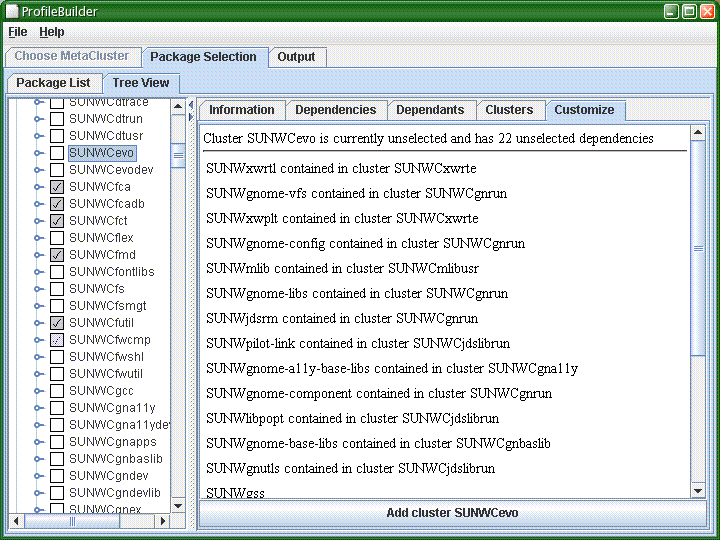
There's a lot more work than can be done here. The interface, while workable, is rather crude. I would like to get it to construct a reasonable jumpstart profile based on an installed system, and it would be nice to be able to feed it all my old profiles and get it to fix them up for me. And I'm sure there are many other ways it could be improved, or used in different ways.
So if you have any suggestions, give me a shout!
Sunday, September 09, 2007
Solview update
I've just released a new version of solview.
If you've tried to run solview in a non global zone, then you'll find that it didn't work. (Thanks to Tony Curtis for spotting this!) This was due to an ignorant and lazy programmer. Yup, I hadn't tested it in a non global zone for a while.
This latest update actually checks that the files it relies on to grab the information it's going to display exist, and behaves properly if they don't. I'm not saying that it works correctly in all circumstances, but it does work in the cases I've tested, whereas previous versions were rather more fragile.
If you've tried to run solview in a non global zone, then you'll find that it didn't work. (Thanks to Tony Curtis for spotting this!) This was due to an ignorant and lazy programmer. Yup, I hadn't tested it in a non global zone for a while.
This latest update actually checks that the files it relies on to grab the information it's going to display exist, and behaves properly if they don't. I'm not saying that it works correctly in all circumstances, but it does work in the cases I've tested, whereas previous versions were rather more fragile.
JKstat update
It's been a bit quiet on the JKstat front recently (summer holidays may have had something to do with that).
I've done a little bit of cleanup I've been meaning to for a while - getting rid of fixed text strings and replacing them with resources, making localization possible.
I've also added a little chart feature - when charting a statistic, it's now possible to add other statistics from that kstat to the chart.
Nothing earth-shattering, but it still represents steady progress and so there's now a new version available for download.
I've done a little bit of cleanup I've been meaning to for a while - getting rid of fixed text strings and replacing them with resources, making localization possible.
I've also added a little chart feature - when charting a statistic, it's now possible to add other statistics from that kstat to the chart.
Nothing earth-shattering, but it still represents steady progress and so there's now a new version available for download.
Subscribe to:
Posts (Atom)