Sunday, June 24, 2007

New jkstat version - real progress
I've let loose a new version of JKstat, also available from the jkstat project page.
This is version 0.19, and represents real progress. I'll start with some of the fiddly stuff: I've got rid of all the individual utility scripts (they were breeding out of control) and replaced them with a single jkstat script that takes subcommands. I've removed the native methods for looking up individual statistics, as there was no possibility of error checking (like to see if the value returned was valid). There's an client for nfsstat and the start of one to emulate the kstat(1M) perl client. I've got a swing widget that allows you to add a menu to any java client from which you can launch some of the demos.
The big feature is that I can now detect changes in the underlying kstat chain. I've added another class to handle this, so it's responsible for working out whether something has changed, and which kstats have been added and removed. This wasn't quite as big a job as I had feared.
Getting the demos to use this was somewhat more difficult. In particular, the browser took far more work than I ever expected. The kstats are in a tree, they're presented using a JTree, so you just update the tree, right. Wrong! I had originally placed the kstats into a Hashtable (it's a natural things to do), passed that to the JTree. Then Tom Erickson helped me out by creating a sorted Map, and a revised JTree that could take a Map. (And why some of the java swing components haven't moved into the 21st century and become aware of the Collections framework is beyond me.) I wasted a lot of time thinking I could update the Map and get the tree to refresh its view of the world, but it just didn't work. In the end I had to get rid of that and construct my own model, doing everything manually. Ugh.
It's not finished. Not all the demos handle updates. (Those using tables do - that was easy.) And the browser has a couple of cosmetic flaws: the newly added kstats aren't currently sorted correctly, and if you're watching a kstat that gets removed it doesn't tell you that anything has happened. But it's a major step forward and I'm going to take a deep breath and use this for a while before diving back in.
This is version 0.19, and represents real progress. I'll start with some of the fiddly stuff: I've got rid of all the individual utility scripts (they were breeding out of control) and replaced them with a single jkstat script that takes subcommands. I've removed the native methods for looking up individual statistics, as there was no possibility of error checking (like to see if the value returned was valid). There's an client for nfsstat and the start of one to emulate the kstat(1M) perl client. I've got a swing widget that allows you to add a menu to any java client from which you can launch some of the demos.
The big feature is that I can now detect changes in the underlying kstat chain. I've added another class to handle this, so it's responsible for working out whether something has changed, and which kstats have been added and removed. This wasn't quite as big a job as I had feared.
Getting the demos to use this was somewhat more difficult. In particular, the browser took far more work than I ever expected. The kstats are in a tree, they're presented using a JTree, so you just update the tree, right. Wrong! I had originally placed the kstats into a Hashtable (it's a natural things to do), passed that to the JTree. Then Tom Erickson helped me out by creating a sorted Map, and a revised JTree that could take a Map. (And why some of the java swing components haven't moved into the 21st century and become aware of the Collections framework is beyond me.) I wasted a lot of time thinking I could update the Map and get the tree to refresh its view of the world, but it just didn't work. In the end I had to get rid of that and construct my own model, doing everything manually. Ugh.
It's not finished. Not all the demos handle updates. (Those using tables do - that was easy.) And the browser has a couple of cosmetic flaws: the newly added kstats aren't currently sorted correctly, and if you're watching a kstat that gets removed it doesn't tell you that anything has happened. But it's a major step forward and I'm going to take a deep breath and use this for a while before diving back in.
Monday, June 18, 2007
Solaris metacluster sizes
As part of the Indiana discussion, I was looking at the installed sizes of various Solaris clusters of packages. The idea is to work out where all the space is going so as to be able to trim an OpenSolaris distribution onto a single CD. Depending on compression, this might allow something just over 1G of software.
A minor extension let me do the same for the various metaclusters you can choose from in the Solaris installer. And the sizes of those on a Solaris 10 update 3 x86 system are like this:
157.945M : SUNWCmreq
168.594M : SUNWCrnet
195.372M : SUNWCreq
2010.12M : SUNWCuser
2579.84M : SUNWCprog
2614.19M : SUNWCall
2614.2M : SUNWCXall
This confirms what we've known all along, that the small clusters are tiny, the other install clusters are huge, and there's a great big gap between the two extremes. More than that, the end user cluster misses out on a lot of stuff that would be really valuable to an individual user.
(I would recommend to anyone who wants to customize the packages when installing a Solaris system - either using jumpstart or interactively - that they start with either SUNWCrnet or SUNWCall, as the others don't help you much at all.)
The snag with building a CD sized distribution is that the target size is right in the middle of the gaping chasm between a fully functional (SUNWCprog) and minimized (SUNWCrnet) layout.
Fortunately, things aren't quite as bad as they look. These numbers are for a regular Solaris system. This includes a fair amount of software that isn't freely redistributable, so all the numbers shrink. Sometimes by a lot, as if you start taking StarOffice or java out then you save significant amounts of diskspace.
A minor extension let me do the same for the various metaclusters you can choose from in the Solaris installer. And the sizes of those on a Solaris 10 update 3 x86 system are like this:
157.945M : SUNWCmreq
168.594M : SUNWCrnet
195.372M : SUNWCreq
2010.12M : SUNWCuser
2579.84M : SUNWCprog
2614.19M : SUNWCall
2614.2M : SUNWCXall
This confirms what we've known all along, that the small clusters are tiny, the other install clusters are huge, and there's a great big gap between the two extremes. More than that, the end user cluster misses out on a lot of stuff that would be really valuable to an individual user.
(I would recommend to anyone who wants to customize the packages when installing a Solaris system - either using jumpstart or interactively - that they start with either SUNWCrnet or SUNWCall, as the others don't help you much at all.)
The snag with building a CD sized distribution is that the target size is right in the middle of the gaping chasm between a fully functional (SUNWCprog) and minimized (SUNWCrnet) layout.
Fortunately, things aren't quite as bad as they look. These numbers are for a regular Solaris system. This includes a fair amount of software that isn't freely redistributable, so all the numbers shrink. Sometimes by a lot, as if you start taking StarOffice or java out then you save significant amounts of diskspace.
Sunday, June 03, 2007
solview does patches
I updated solview so it now shows patches. It gets most of this for free, by looking at the installed packages. So you get the standard stuff from
showrev -p, with the packages having a short description, plus it will display the readme file for the patch if it can find it. Next step is to parse the patchdiag.xref file to work out what needs updating, like pca does.
Sunday, May 13, 2007
Solview, JPack
Last week I added contents file parsing to solview.
More recently, Michal Pryc announced that he was working on JPack, an easy software manager and installer written in Java.
Now, the current focus of these tools is slightly different - solview is about analysing what your system has, JPack aims to make adding new software painless.
I was planning to add package management to solview at some point, but probably won't bother now - there seems little point in duplicating the work in JPack so I could just reuse that, and hopefully I'll be able to contribute to JPack as well.
Motivated by the rather better look of the GUI in JPack, I had a little go at reorganising the layout in solview so that the package list is done as a table. It does look better. I also did some refactoring of the code - both to make it more usable by other projects (such as JPack), and to remind myself how it all worked.
So there's a new version of solview now available, with the above mentioned refactoring and layout changes, and with the slow operations done in the background with a SwingWorker.
More recently, Michal Pryc announced that he was working on JPack, an easy software manager and installer written in Java.
Now, the current focus of these tools is slightly different - solview is about analysing what your system has, JPack aims to make adding new software painless.
I was planning to add package management to solview at some point, but probably won't bother now - there seems little point in duplicating the work in JPack so I could just reuse that, and hopefully I'll be able to contribute to JPack as well.
Motivated by the rather better look of the GUI in JPack, I had a little go at reorganising the layout in solview so that the package list is done as a table. It does look better. I also did some refactoring of the code - both to make it more usable by other projects (such as JPack), and to remind myself how it all worked.
So there's a new version of solview now available, with the above mentioned refactoring and layout changes, and with the slow operations done in the background with a SwingWorker.
Monday, May 07, 2007
solview - includes contents
A little bit of work this weekend and I've let out a new version of solview.
No sign of the promised jumpstart profile builder, though.
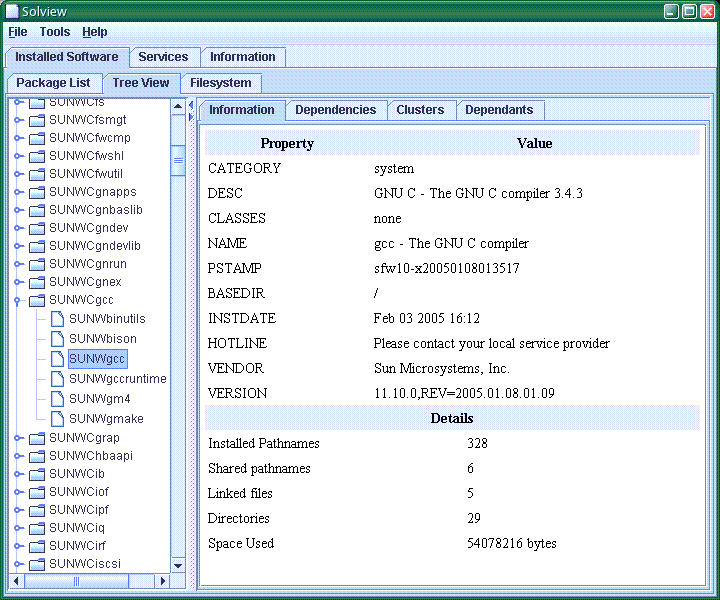
But what is present now is a contents file parser. This allows me to add a summary of the number of files and space used to each package (and to each cluster). For example:

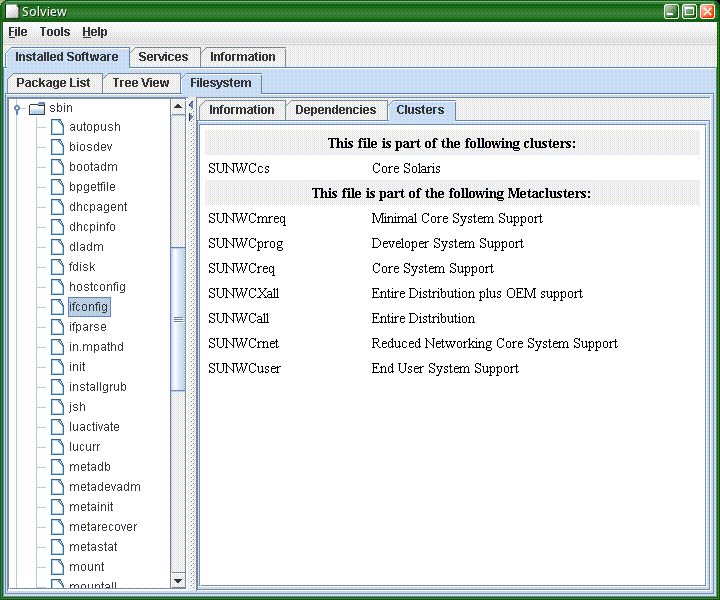
And in addition I added a filesystem browser so you can choose a file and see what packages and clusters it's included in:

There's a slight amount of lunacy involved in parsing the contents file. Don't be surprised to see OutOfMemory errors, as the memory usage is fairly high (several hundred meg, commonly).
No sign of the promised jumpstart profile builder, though.
But what is present now is a contents file parser. This allows me to add a summary of the number of files and space used to each package (and to each cluster). For example:
And in addition I added a filesystem browser so you can choose a file and see what packages and clusters it's included in:
There's a slight amount of lunacy involved in parsing the contents file. Don't be surprised to see OutOfMemory errors, as the memory usage is fairly high (several hundred meg, commonly).
Monday, April 23, 2007
Phoronix and Solaris
Interesting: Phoronix now supports Solaris. See the article.
Not only an endorsement of the growth of interest in Solaris, but hopefully another source of information regarding hardware compatibility for Solaris.
Not only an endorsement of the growth of interest in Solaris, but hopefully another source of information regarding hardware compatibility for Solaris.
Sunday, April 15, 2007
JKstat 0.17 - includes charts
I've been gradually continuing work on JKstat. The latest version (0.17) has a number of code cleanups, but also includes charting capability. (Uses JFreeChart.)
You can right-click on any numerical statistic in kstatbrowser and chart that statistic. Here's an example:

You can right-click on any numerical statistic in kstatbrowser and chart that statistic. Here's an example:
Sunday, March 25, 2007
JKstat 0.15
I've made a new version of JKstat available.
There are quite a few changes underneath. I'm very grateful to Tom Erickson for sending me a bunch of enhancements and fixes. Some of them made it into this version fairly directly - particularly the sorting of kstats in the browser.
This version has also been revamped and now requires Java 5. I had been thinking about modernizing the code for a while, but had always put it off. Tom again provided the impetus, as he went ahead and used generics in the fixed version he sent back to me. I reimplemented it myself, so I could actually understand what I was doing to my code.
I actually went and rewrote solview first. This was a useful exercise in itself, as one of the advantages of using generics is that it makes you think harder about the way you define classes and how your code is structured. In solview I was in the middle of cleaning the code up to define Solaris packages and install clusters as proper objects, and using generics made sure I actually got that right.
JKstat was also accepted as an OpenSolaris project, so I'm going to be moving development over there soon.
There are quite a few changes underneath. I'm very grateful to Tom Erickson for sending me a bunch of enhancements and fixes. Some of them made it into this version fairly directly - particularly the sorting of kstats in the browser.
This version has also been revamped and now requires Java 5. I had been thinking about modernizing the code for a while, but had always put it off. Tom again provided the impetus, as he went ahead and used generics in the fixed version he sent back to me. I reimplemented it myself, so I could actually understand what I was doing to my code.
I actually went and rewrote solview first. This was a useful exercise in itself, as one of the advantages of using generics is that it makes you think harder about the way you define classes and how your code is structured. In solview I was in the middle of cleaning the code up to define Solaris packages and install clusters as proper objects, and using generics made sure I actually got that right.
JKstat was also accepted as an OpenSolaris project, so I'm going to be moving development over there soon.
Saturday, March 24, 2007
OpenSolaris priorities
Before the OGB election there was the OpenSolaris Comunity Priorities vote.
Looking at the result, and the clear winner in terms of priorities is the public defect management system. Yep, I put that at number 1 too. (I think...)
The OpenSolaris Bugs interface did get revamped recently, and that was a significant improvement. However, it's still not really doing anything for OpenSolaris - it's just a way to give a limited view of a subset of Sun's bug database.
Importantly, there's no other integration with anything else the community might be doing, and no way for a community member to interact with the system. How can it be improved?
Here are a couple of things I would like to see:
Eliminate all the crud. The database is littered with all sorts of things that aren't bugs, and still contains bugs that are antique. We need to take some of the open bugs forward, but most of the database has no relevance to the current codebase.
I think this means we need a completely separate database. And bugs that Sun generate through their support organization need to be put into the public OpenSolaris bug database the same way that Sun currently logs bugs against external projects such as Gnome.
We need to allow community members to participate in the triage process, and allow comments and followups to further refine the bugs and provide sample solutions, test cases, and prioritization. This extra interaction will build a stronger community, and provide ways for more people to get involved.
And the database needs to be linked into the whole workflow, so that there's a way to see who might be working on a particular bug and contact them.
The bug database is the crucial missing link. We want to improve and develop OpenSolaris, and to do that we first need to know what's broken and what's missing.
Looking at the result, and the clear winner in terms of priorities is the public defect management system. Yep, I put that at number 1 too. (I think...)
The OpenSolaris Bugs interface did get revamped recently, and that was a significant improvement. However, it's still not really doing anything for OpenSolaris - it's just a way to give a limited view of a subset of Sun's bug database.
Importantly, there's no other integration with anything else the community might be doing, and no way for a community member to interact with the system. How can it be improved?
Here are a couple of things I would like to see:
Eliminate all the crud. The database is littered with all sorts of things that aren't bugs, and still contains bugs that are antique. We need to take some of the open bugs forward, but most of the database has no relevance to the current codebase.
I think this means we need a completely separate database. And bugs that Sun generate through their support organization need to be put into the public OpenSolaris bug database the same way that Sun currently logs bugs against external projects such as Gnome.
We need to allow community members to participate in the triage process, and allow comments and followups to further refine the bugs and provide sample solutions, test cases, and prioritization. This extra interaction will build a stronger community, and provide ways for more people to get involved.
And the database needs to be linked into the whole workflow, so that there's a way to see who might be working on a particular bug and contact them.
The bug database is the crucial missing link. We want to improve and develop OpenSolaris, and to do that we first need to know what's broken and what's missing.
Polls and voter apathy
I've been sitting on the fringes of the OpenSolaris Governing Board Election. I would have liked to have been more involved, but have been struggling to find time. Strike one for apathy!
(And, while I did consider putting myself forward as a candidate, the fact that I haven't been able to effectively contribute up to this stage also implies that I wouldn't be able to do the job properly in the unlikely event that I were to be elected.)
There does seem to be a fairly low turnout so far. There have been a number of calls for people to get their finger out, and we seem to be creeping closer to a quorum.
Alan Coopersmith had a look at the contributors and communities. This shows what we've known all along - that the different communities have very different levels of participation in the governance process. Looking at the way that core contributors are distributed, it's not clear to me now that relying on communities to generate the initial list was - or is - a good thing.
There seems to be a view that reorganising the communities is going to be a big task for the incoming OGB. (If one gets elected, that is.) I'm not so sure about this. I feel that we're trying to build too much officialdom into the community structure, when in reality the communities are more social structures connected by a common interest. But more on that later.
I'm fortunate that I am classed as a core contributor and, yes, I've voted.
Perhaps core contributor status should be automatically be rescinded from those who haven't bothered to vote?
(And, while I did consider putting myself forward as a candidate, the fact that I haven't been able to effectively contribute up to this stage also implies that I wouldn't be able to do the job properly in the unlikely event that I were to be elected.)
There does seem to be a fairly low turnout so far. There have been a number of calls for people to get their finger out, and we seem to be creeping closer to a quorum.
Alan Coopersmith had a look at the contributors and communities. This shows what we've known all along - that the different communities have very different levels of participation in the governance process. Looking at the way that core contributors are distributed, it's not clear to me now that relying on communities to generate the initial list was - or is - a good thing.
There seems to be a view that reorganising the communities is going to be a big task for the incoming OGB. (If one gets elected, that is.) I'm not so sure about this. I feel that we're trying to build too much officialdom into the community structure, when in reality the communities are more social structures connected by a common interest. But more on that later.
I'm fortunate that I am classed as a core contributor and, yes, I've voted.
Perhaps core contributor status should be automatically be rescinded from those who haven't bothered to vote?
Thursday, March 08, 2007
Spring Clean and Upgrade
I've been doing a bit of a spring clean and upgrade on some of my home systems.
The family PC had its memory doubled. It's survived 3 years with only 512M, which ought to be enough but it's obviously running out. We use fast user switching so there are usually 4 people logged in. That shouldn't be so bad, but it implies 4 web browsers and they guzzle memory like it's going out of fashion. I also replaced the broken DVD-ROM with a working dvd writer.
I think it's the first time the case has been opened for 3 years. And it was filthy inside, so it got a thorough vacuuming.
Next step was a couple of Sun workstations. I use one for OpenSolaris development, and I shuffled that up from build 55 to build 59. I also took a gamble on rebuilding one of the children's systems from an essentially unpatched FCS version of Solaris 10 to the latest Solaris Express release - the same build 59. Only complaint so far is the placement of the tab close buttons in Firefox 2 versus Mozilla.
Next step - run Nexenta using the VMware player.
The family PC had its memory doubled. It's survived 3 years with only 512M, which ought to be enough but it's obviously running out. We use fast user switching so there are usually 4 people logged in. That shouldn't be so bad, but it implies 4 web browsers and they guzzle memory like it's going out of fashion. I also replaced the broken DVD-ROM with a working dvd writer.
I think it's the first time the case has been opened for 3 years. And it was filthy inside, so it got a thorough vacuuming.
Next step was a couple of Sun workstations. I use one for OpenSolaris development, and I shuffled that up from build 55 to build 59. I also took a gamble on rebuilding one of the children's systems from an essentially unpatched FCS version of Solaris 10 to the latest Solaris Express release - the same build 59. Only complaint so far is the placement of the tab close buttons in Firefox 2 versus Mozilla.
Next step - run Nexenta using the VMware player.
Tuesday, February 20, 2007
A new use for a D1000 array
I found a new use for a D1000 array last night.
We bought a pallet-load off eBay a while back. We only actually needed one, but the whole pallet was no more expensive. So the first one got used for the purpose for which it was bought, and I've used a couple more filled up with old drives to test ZFS and the like.
We just piled the rest up in a store-room.
Which is where they had stayed for a few weeks harmlessly gathering dust.
Last night I went in there to look for some cables, and was somewhat annoyed to find that the door wouldn't open when I tried to get out. The lock release did absolutely nothing.
What you have to understand is that this was an old comms or server room. So that's a security and fire door in my way. No windows. No phone. My mobile is on my desk. It's almost soundproof as well, and it's getting late.
I did manage to attract someone's attention as they were passing in the corridor, and we tried all sorts of tricks to get the stupid door to open, with no success.
Eventually I piled all the D1000s up and stood on top of them. (Which just goes to show that buying quality kit is always worthwhile. You try this trick with cheap kit and it will fold under the weight.) Originally I was hoping to get into the false ceiling and work my way through, but even that was a bit of a stretch and very cluttered.
Eventually we took out the panel above the door and I got out that way.
See, I knew this old kit would come in useful some day!
We bought a pallet-load off eBay a while back. We only actually needed one, but the whole pallet was no more expensive. So the first one got used for the purpose for which it was bought, and I've used a couple more filled up with old drives to test ZFS and the like.
We just piled the rest up in a store-room.
Which is where they had stayed for a few weeks harmlessly gathering dust.
Last night I went in there to look for some cables, and was somewhat annoyed to find that the door wouldn't open when I tried to get out. The lock release did absolutely nothing.
What you have to understand is that this was an old comms or server room. So that's a security and fire door in my way. No windows. No phone. My mobile is on my desk. It's almost soundproof as well, and it's getting late.
I did manage to attract someone's attention as they were passing in the corridor, and we tried all sorts of tricks to get the stupid door to open, with no success.
Eventually I piled all the D1000s up and stood on top of them. (Which just goes to show that buying quality kit is always worthwhile. You try this trick with cheap kit and it will fold under the weight.) Originally I was hoping to get into the false ceiling and work my way through, but even that was a bit of a stretch and very cluttered.
Eventually we took out the panel above the door and I got out that way.
See, I knew this old kit would come in useful some day!
Sunday, February 11, 2007
Updated jkstat
It's been a while (almost a year) since I last updated jkstat, but I've just put version 0.13 up for download.
For those that don't know, jkstat is a Java jni interface to Solaris kstats, allowing you to access a wide range of useful data held by the Solaris kernel from a Java application.
One thing I have done is this version is try to improve the look of the sample applications, most of which has been achieved by replacing the rather clumsy GridLayout with SpringLayout.
For those that don't know, jkstat is a Java jni interface to Solaris kstats, allowing you to access a wide range of useful data held by the Solaris kernel from a Java application.
One thing I have done is this version is try to improve the look of the sample applications, most of which has been achieved by replacing the rather clumsy GridLayout with SpringLayout.
Thursday, February 08, 2007
Impressed with Xfce
I've been having a play with Xfce on one of my Solaris workstations.
And I have to say I've been very impressed. It's reasonably fast and light. It has an increasing number of applications. The file manager - Thunar - is quite nice.
There are two things that I think are in favour of Xfce. The first is that because of its common roots with gnome it can leverage all the gnome applications and GTK themes. The second is that it is very polished. There is a good section of window manager themes, and the artwork is very well done.
All in all it's well worth a look.
And I have to say I've been very impressed. It's reasonably fast and light. It has an increasing number of applications. The file manager - Thunar - is quite nice.
There are two things that I think are in favour of Xfce. The first is that because of its common roots with gnome it can leverage all the gnome applications and GTK themes. The second is that it is very polished. There is a good section of window manager themes, and the artwork is very well done.
All in all it's well worth a look.
Monday, January 22, 2007
Sun, Intel - friends?
OK, so Sun and Intel made a big fuss about some deal or other (one which doesn't really set the pulse racing, mind). What I found ironic was the ticker underneath the main feature on the Sun home page, where they put the knife into Itanium.
I remember Sun recently selling a number of Intel powered systems. The LX50 was a nice box - even if it was pushed with SunLinux. The V60x was OK, but I quite liked the V65x, and that sort of system (6 internal drives) is something that would be quite valuable. And the B200x blade was quite a marvel - twin hyperthreaded Xeons and a decent memory configuration in a tiny package.
I expect closer collaboration will improve driver support for Solaris, but I'm also hoping for a wider range of systems designed for Solaris to give us a breadth and variety of system configurations that Sun themselves seem disinclined to supply.
I remember Sun recently selling a number of Intel powered systems. The LX50 was a nice box - even if it was pushed with SunLinux. The V60x was OK, but I quite liked the V65x, and that sort of system (6 internal drives) is something that would be quite valuable. And the B200x blade was quite a marvel - twin hyperthreaded Xeons and a decent memory configuration in a tiny package.
I expect closer collaboration will improve driver support for Solaris, but I'm also hoping for a wider range of systems designed for Solaris to give us a breadth and variety of system configurations that Sun themselves seem disinclined to supply.
Sunday, January 14, 2007
Backup Blues
Taking system backups is an essential part of any IT operation, but seems to involve an awful lot of pain.
Over the years I've generally been happy with Legato (now EMC) NetWorker, sometimes known as Sun StorEdge Backup or something similar. What I really like about it is that it's very low maintenance - easy to set up and configure, and gets on with its job quietly in the background without any fuss.
I was a little concerned that the latest version has dropped the old nwadmin X-windows based GUI in favour of some Java client-server thingummy. I still don't really like the java interface, but as I previously mentioned it's pretty low maintenance so you don't need to spend much time using it, and it's generally easy enough to use. The one downside to it is that the licensing is a bit more complicated, and the license registration instructions explicitly refer to the old GUI.
I'm currently using NetWorker for one half of my backups. I put in a new server and tape library and moved the NetWorker license across. The transition has been very successful, although the primary win is that I replaced an L20 with 2 DLT-7000 drives with a C4 with 2 LTO3 drives. The old system simply didn't have the capacity or the performance - backups would take days, and some backup runs came in at over twice the capacity of the library. Now they take hours and fit onto a couple of tapes.
The other half of my backup story is more appropriate for the tile of this post. There, we're using an alternative product. OK, specifically, NetBackup. And it's much more trouble than NetWorker has ever been.
I'm trying hard to give a balanced view here. After all, NetBackup is widely used and must have some good points, right? Maybe...
The first thing is that NetBackup is very high maintenance, at least compared to NetWorker. It needs constant attention paid to it, seeming to go off and hide in a corner if you don't give it constant encouragement. I'm not surprised that large organizations have dedicated NetBackup administrators, or even teams thereof.
The second thing is that I (and I know I'm not the only one) have trouble with the way you actually define backup schedules. In NetWorker it's trivially easy - you define what you want backed up, what level of backups you want, and when to do it. In NetBackup you mess around with backup windows, frequencies, policies, and schedules. Again, this is much higher maintenance - I usually need to manually configure half a dozen screens in NetBackup as opposed to simply selecting one option under NetWorker.
The third thing is reliability. The only time I have known NetWorker fail to do a backup is if I've run out of tape. NetBackup seems to throw fits all over the place. We see regular timeouts, errors when it's outside the backup window, and occasional (once or twice a month) where the whole thing freezes up and needs a forceful restart. I've just upgraded the NetBackup server itself, and after tuning got acceptable performance (the default performance was dreadful), but the catalog backup takes over a day for something that ought to take 20 minutes, and renders the machine completely unresponsive while it's at it.
I'm tempted to replace the NetBackup installation with NetWorker, which raises a number of issues. I'm happy that it will be fairly painless on the Unix side, but I'm less sure about the Windows side which also needs backing up. While I have run NetWorker on Windows, it became apparent fairly quickly that it was basically a Unix product and looked to be in alien territory. And my experience of NetWorker's application modules (as needed for the likes of databases, exchange and the like) hasn't been entirely positive. So I'm thinking of a completely separate system for the Winddows backups.
I've tested a number of other backup products, but under Unix. And there it was obvious that most of the Windows products looked completely lost under Unix. I haven't really come across a truly cross-platform backup solution, and it's not obvious to me that such a thing actually exists.
Given how conceptually simple backups are, is it asking too much to have solutions that just work?
Over the years I've generally been happy with Legato (now EMC) NetWorker, sometimes known as Sun StorEdge Backup or something similar. What I really like about it is that it's very low maintenance - easy to set up and configure, and gets on with its job quietly in the background without any fuss.
I was a little concerned that the latest version has dropped the old nwadmin X-windows based GUI in favour of some Java client-server thingummy. I still don't really like the java interface, but as I previously mentioned it's pretty low maintenance so you don't need to spend much time using it, and it's generally easy enough to use. The one downside to it is that the licensing is a bit more complicated, and the license registration instructions explicitly refer to the old GUI.
I'm currently using NetWorker for one half of my backups. I put in a new server and tape library and moved the NetWorker license across. The transition has been very successful, although the primary win is that I replaced an L20 with 2 DLT-7000 drives with a C4 with 2 LTO3 drives. The old system simply didn't have the capacity or the performance - backups would take days, and some backup runs came in at over twice the capacity of the library. Now they take hours and fit onto a couple of tapes.
The other half of my backup story is more appropriate for the tile of this post. There, we're using an alternative product. OK, specifically, NetBackup. And it's much more trouble than NetWorker has ever been.
I'm trying hard to give a balanced view here. After all, NetBackup is widely used and must have some good points, right? Maybe...
The first thing is that NetBackup is very high maintenance, at least compared to NetWorker. It needs constant attention paid to it, seeming to go off and hide in a corner if you don't give it constant encouragement. I'm not surprised that large organizations have dedicated NetBackup administrators, or even teams thereof.
The second thing is that I (and I know I'm not the only one) have trouble with the way you actually define backup schedules. In NetWorker it's trivially easy - you define what you want backed up, what level of backups you want, and when to do it. In NetBackup you mess around with backup windows, frequencies, policies, and schedules. Again, this is much higher maintenance - I usually need to manually configure half a dozen screens in NetBackup as opposed to simply selecting one option under NetWorker.
The third thing is reliability. The only time I have known NetWorker fail to do a backup is if I've run out of tape. NetBackup seems to throw fits all over the place. We see regular timeouts, errors when it's outside the backup window, and occasional (once or twice a month) where the whole thing freezes up and needs a forceful restart. I've just upgraded the NetBackup server itself, and after tuning got acceptable performance (the default performance was dreadful), but the catalog backup takes over a day for something that ought to take 20 minutes, and renders the machine completely unresponsive while it's at it.
I'm tempted to replace the NetBackup installation with NetWorker, which raises a number of issues. I'm happy that it will be fairly painless on the Unix side, but I'm less sure about the Windows side which also needs backing up. While I have run NetWorker on Windows, it became apparent fairly quickly that it was basically a Unix product and looked to be in alien territory. And my experience of NetWorker's application modules (as needed for the likes of databases, exchange and the like) hasn't been entirely positive. So I'm thinking of a completely separate system for the Winddows backups.
I've tested a number of other backup products, but under Unix. And there it was obvious that most of the Windows products looked completely lost under Unix. I haven't really come across a truly cross-platform backup solution, and it's not obvious to me that such a thing actually exists.
Given how conceptually simple backups are, is it asking too much to have solutions that just work?
Wednesday, December 27, 2006
Fun with NVIDIA driver
I have a Sun W2100z running Solaris. It's a fantastic machine, but the graphics has never been too hot. It's got the entry level graphics card - an NVS 280 if I remember correctly - and I've been using the bundled nv driver as I wasn't aware that the accelerated driver could do much better.
I was trying to get DVD playback to work, and gxine seems to work (after I had built and installed libdvdcss), but was rather slow and I noticed that Xorg seemed to be pegging a whole cpu. In addition, it might be neat to get Looking Glass to work.
So I ambled over to NVIDIA and their Solaris Driver downloads, and noticed that my graphics card was listed as one of those supported. I downloaded and installed the latest version (9764), and that didn't work. I get an error message as it boots that seems to be from the nvidia driver, but then the system immediately reboots. Not good. (I went into failsafe from the grub menu and used pkgrm to delete the two packages to recover.)
Then I had a look in the forums and noticed a message about a legacy release (9631). Now, it doesn't really explain what the legacy release is in this case (the information on the download page about legacy releases applies to Linux), and there isn't a link to the legacy release on the download page itself, but to cut a long story short - the 9631 legacy release works fine on my entry level box. DVD playback is a bit smoother, although still not brilliant, but the cpu load is pretty negligible compared to before.
If you, like me, have an entry-level W2100z with an NVS280 graphics card, then you may be advised to use the NVIDIA legacy driver rather than the latest and greatest.
I was trying to get DVD playback to work, and gxine seems to work (after I had built and installed libdvdcss), but was rather slow and I noticed that Xorg seemed to be pegging a whole cpu. In addition, it might be neat to get Looking Glass to work.
So I ambled over to NVIDIA and their Solaris Driver downloads, and noticed that my graphics card was listed as one of those supported. I downloaded and installed the latest version (9764), and that didn't work. I get an error message as it boots that seems to be from the nvidia driver, but then the system immediately reboots. Not good. (I went into failsafe from the grub menu and used pkgrm to delete the two packages to recover.)
Then I had a look in the forums and noticed a message about a legacy release (9631). Now, it doesn't really explain what the legacy release is in this case (the information on the download page about legacy releases applies to Linux), and there isn't a link to the legacy release on the download page itself, but to cut a long story short - the 9631 legacy release works fine on my entry level box. DVD playback is a bit smoother, although still not brilliant, but the cpu load is pretty negligible compared to before.
If you, like me, have an entry-level W2100z with an NVS280 graphics card, then you may be advised to use the NVIDIA legacy driver rather than the latest and greatest.
Tuesday, December 05, 2006
Jumpstart Profile Builder
One of my little projects is to write an interactive jumpstart profile builder, so that you can play with Solaris software selections, and construct a working jumpstart profile.
The problem currently is that you can, with some effort, create a jumpstart profile. But the only real way to test it is to use it to install a system, and either see what works and what doesn't, or look at the installation log to see what package dependencies you messed up on. Eventually you can get quite good at this, but it shouldn't be this hard.
You can select packages in the interactive install, but the dependency resolution is awful. It tells you what the dependencies that failed are, but doesn't give you a way to feed that back into the gui to resolve them. Nor does it tell you what dependencies are required as you look at the individual packages. And once you've selected your software, it will install it but you can't go from that to create a jumpstart profile to automatically install the next set of systems.
I have most of the base code already, in the shape of Solview. That knows how to turn the .clustertoc file (which is where the clusters and metaclusters are defined) into a tree representation of the packages, that could be used as the basis of a selection tree. And it can evaluate the dependencies. I've also got code that can describe a jumpstart profile.
Where I'm currently struggling a little is the actual interface. Using a java swing JTree as the base is fairly straightforward - this is what Solview does already. And I need a custom cell renderer to add checkboxes to show whether the software package is selected or not (or, in the case of an installed system, whether it's been installed or not). But then I got to thinking and I can't use the regular JCheckBox, as there are more states that I wish to display than JCheckBox gives me out of the box.
I've had a quick look around with the help of google, and I'm obviously not the first person to have requirements of this type. And there is a fairly large amount of sample code out there. Unfortunately it appears to be fairly complex, and I would be adding a significant amount of extra code, but it doesn't appear that I have much choice.
The problem currently is that you can, with some effort, create a jumpstart profile. But the only real way to test it is to use it to install a system, and either see what works and what doesn't, or look at the installation log to see what package dependencies you messed up on. Eventually you can get quite good at this, but it shouldn't be this hard.
You can select packages in the interactive install, but the dependency resolution is awful. It tells you what the dependencies that failed are, but doesn't give you a way to feed that back into the gui to resolve them. Nor does it tell you what dependencies are required as you look at the individual packages. And once you've selected your software, it will install it but you can't go from that to create a jumpstart profile to automatically install the next set of systems.
I have most of the base code already, in the shape of Solview. That knows how to turn the .clustertoc file (which is where the clusters and metaclusters are defined) into a tree representation of the packages, that could be used as the basis of a selection tree. And it can evaluate the dependencies. I've also got code that can describe a jumpstart profile.
Where I'm currently struggling a little is the actual interface. Using a java swing JTree as the base is fairly straightforward - this is what Solview does already. And I need a custom cell renderer to add checkboxes to show whether the software package is selected or not (or, in the case of an installed system, whether it's been installed or not). But then I got to thinking and I can't use the regular JCheckBox, as there are more states that I wish to display than JCheckBox gives me out of the box.
- Package or cluster selected
- Package or cluster not selected
- Cluster partially selected
- Package or cluster selected and cannot be deselected
I've had a quick look around with the help of google, and I'm obviously not the first person to have requirements of this type. And there is a fairly large amount of sample code out there. Unfortunately it appears to be fairly complex, and I would be adding a significant amount of extra code, but it doesn't appear that I have much choice.
Wednesday, November 22, 2006
T2000 vs bison
This wasn't a benchmark, or even meant as a test, but it was an interesting number nonetheless.
I installed bison today. As I have 3 different families of sytems (Sparc Solaris 8; Sparc Solaris 10; x86 Solaris 10) I have 3 copies of /usr/local, so build on 3 different systems. Anyway, after building bison (and the T2000 allows a very parallel make that some builds can take advantage of) I ran a make check.
The results were quite interesting. My sub $1000 Opteron 146 system took 107s. An old V880 (750MHz US-III) took 529s. The T2000 took a whopping 794s. This really isn't looking good.
I installed bison today. As I have 3 different families of sytems (Sparc Solaris 8; Sparc Solaris 10; x86 Solaris 10) I have 3 copies of /usr/local, so build on 3 different systems. Anyway, after building bison (and the T2000 allows a very parallel make that some builds can take advantage of) I ran a make check.
The results were quite interesting. My sub $1000 Opteron 146 system took 107s. An old V880 (750MHz US-III) took 529s. The T2000 took a whopping 794s. This really isn't looking good.
Subscribe to:
Posts (Atom)